

Educational toys are more than a nice object on a shelf. A well-chosen toy helps a child learn through play: expand vocabulary and develop memory, logical thinking and finger dexterity. But the same toy may be too difficult for a two-year-old and too easy for a seven-year-old. In this article we look at how to choose educational toys by the child’s age and what each of them really develops.
How is an educational toy different from an ordinary one?
An educational toy has a clear learning task: find a pair, put together, name, compare or build. It encourages the child to think and talk rather than just watch. The best educational toys can be played in different ways – alone, with an adult or in a group – and “grow” with the child, because the tasks can be made gradually harder. Moreover, an educational toy does not have to be electronic or have a screen – simple games in which the child thinks, talks and works with their hands often bring the most benefit.
Educational toys by age
For children aged 2–3
At this age children learn to grasp, fit in, recognise and name objects. Simple, sturdy, large pieces and realistic pictures work best. For example, the “Bathroom” wooden inset puzzle develops hand coordination and introduces everyday objects, while the wooden association and memory game with real photos helps the child link textures to real objects and name them.
Children of this age also love creative activities: finger paints or chunky crayons develop hand movements and let them “speak” in colour for the first time. Talk a lot while playing – name objects, colours and actions, even if the child is not yet speaking.
For children aged 3–5
Preschoolers can already follow simple rules, wait for their turn and complete tasks from a card. This is the time for memory, attention and language games. Maxi-Memory “Animals” with large cards develops visual memory, and the game “Where is it?” helps children learn spatial and opposite concepts: above and below, inside and outside, near and far.
Simple board games with rules, sequence cards (what happens first and what comes next) and listening games also work well. Vocabulary grows quickly during this period, so it is worth turning every game into a conversation.
For children aged 5–8
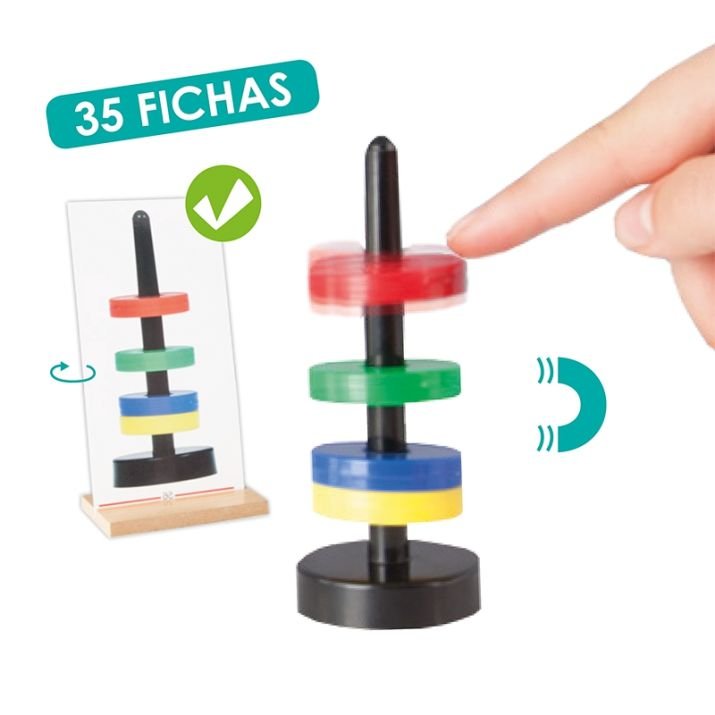
Older children enjoy more complex logical and spatial tasks in which they need to plan, compare and check their solution. The game “Topology” develops the perception of shapes and space, while the magnetic tower invites children to build colourful towers from magnetic rings and introduces them to magnetism.
At this age children enjoy challenges and the chance to check the answer themselves. It is valuable when a game has several difficulty levels – then it lasts a long time and suits both a beginner and a more skilled child.
What do educational toys develop?
- Language – the child names, describes and talks about what they see and do.
- Memory and attention – remembers card positions, sequences and rules.
- Logical and spatial thinking – compares, groups and builds from a model.
- Fine motor skills – grasps, fits in and connects smaller pieces.
- Social skills – plays by the rules, waits for their turn and cooperates.
Five tips for play that really helps learning
- Play together – an adult’s comments and questions turn a game into a lesson without a lesson.
- Talk: ask “what is it?”, “where?”, “why?” and let the child answer in their own words.
- Start with an easier task and make it harder only when the child feels confident.
- Play briefly but often – 10 minutes every day is better than an hour once a week.
- Rotate toys – put some away in a cupboard and bring them out again after a few weeks.
Educational toys for kindergartens and educational institutions
For a kindergarten group or a specialist’s room it is worth choosing sturdy games with large cards and pieces that several children can play at once. Educational institutions can order from us and pay by invoice. You will find more information on the For educational institutions page.
How to recognise a good educational toy
Before buying, ask yourself a few simple questions. If the answer to most of them is “yes”, the toy is likely to be used for a long time.
- Is it clear what the child should do with the toy and what it develops?
- Can it be played in several ways and at several difficulty levels?
- Are the pieces sturdy, of a comfortable size and suitable for the child’s age?
- Are the pictures clear and realistic rather than cluttered?
- Does the toy encourage talking and interaction rather than just pressing buttons?
Language and play: why talking matters
Even the simplest game becomes educational when an adult talks with the child: asks, repeats and expands the child’s sentence. If the child says “dog”, you can answer “yes, a big brown dog is running”. This way the child hears new words and sentence patterns naturally, without pressure. Many of the aids in our shop are also used by speech therapists – precisely because they invite children to talk.
Group play: how to involve several children
In a kindergarten or club, the same game can be played in teams. For example, it is worth starting a memory game with fewer cards and giving more pairs to children who are already doing well. Puzzle or sequencing tasks can be split into pairs – one child searches, the other checks. This way each child gets a suitable challenge, and the group learns to cooperate and wait their turn.
Frequently asked questions
How do I know whether a toy suits my child’s age?
Each product description states the age recommended by the manufacturer. If your child masters a toy very quickly, choose a more challenging one; if a task is too hard, come back to a simpler one after a while.
How many educational toys does a child need?
Not many. A few toys that develop different skills and that you rotate from time to time bring more benefit than a full shelf.
Are wooden toys better than plastic ones?
What matters most is the toy’s task and its quality. Wooden toys are pleasant to touch and long-lasting, but the educational value depends on what the child does with the toy and how.
Are educational toys suitable for children who find talking harder?
Yes, many picture and card games are well suited to encouraging language. If you are concerned about your child’s speech, consult a speech therapist – they will help you choose the most suitable aids and tasks.
Do educational toys make good gifts?
Yes, they are among the most practical gifts. Choose by age and the child’s interests: a sturdy puzzle or picture game for a toddler, a logic or building task with several levels for an older child.
You will find all the educational toys we have selected in the Educational toys for children category. If you are not sure what to choose, write to us – we will help you choose by the child’s age and needs.
You will find all our educational resources for children – speech-therapy tools, sensory resources and learning games – in the O.K. Žaislai shop.