

Creative and drawing supplies
Drawing and creative supplies for children are a child's first tools for leaving a mark on the world: finger paints, dot markers, chunky crayons for the very youngest and light boxes for sand drawing. They are not only about a pretty result but also about the hand – every stroke trains the fingers, pressure control and hand-eye coordination that will be needed when learning to write.
Showing the single result
Showing the single result
How to choose supplies by age?
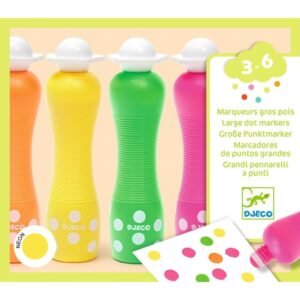
From 18 months finger paints and dot markers work best – they need no precise grip, only the urge to touch and press. From 2–3 years chunky short crayons come in useful: they are too short for a child to hold in a whole fist, so the hand learns the correct grip by itself. From 3–4 years a child can already colour within outlines, so finer supplies and more demanding tasks are suitable.
Creativity as sensory and motor exercise
Finger paints are one of the most effective aids for tactile desensitisation – for children who avoid sticky or wet textures they are a safe, gradual path from avoidance to exploration. Dot markers fill the gap between drawing with a finger and drawing with a pencil: the child already holds a tool but is not yet required to guide a precise line. Short chunky crayons are a classic occupational therapy aid for forming the writing grip.
Frequently asked questions
Do the paints wash off? The ink of Djeco dot markers washes out with water, soap and detergent. We recommend using finger paints only under adult supervision and protecting the work surface.
From what age can a child finger paint? From 18 months – at this age what matters is not the picture but the movement itself and the feel of the texture. Give a large sheet of paper and do not interfere.
What should a nursery or therapy room choose? Large tubes and sets with a palette – they are enough for a group, and the palette makes it possible to control the amount and avoid excessive stimulation.
What is a light box for sand drawing for? Drawing in sand on a lit surface is calming and develops finger movements and hand-eye coordination – it suits sensory activities at home, in kindergarten or in a therapy room. See the LED light box for sand drawing.
Looking for more aids to develop the hand? Have a look at sensory aids and tactile toys.