

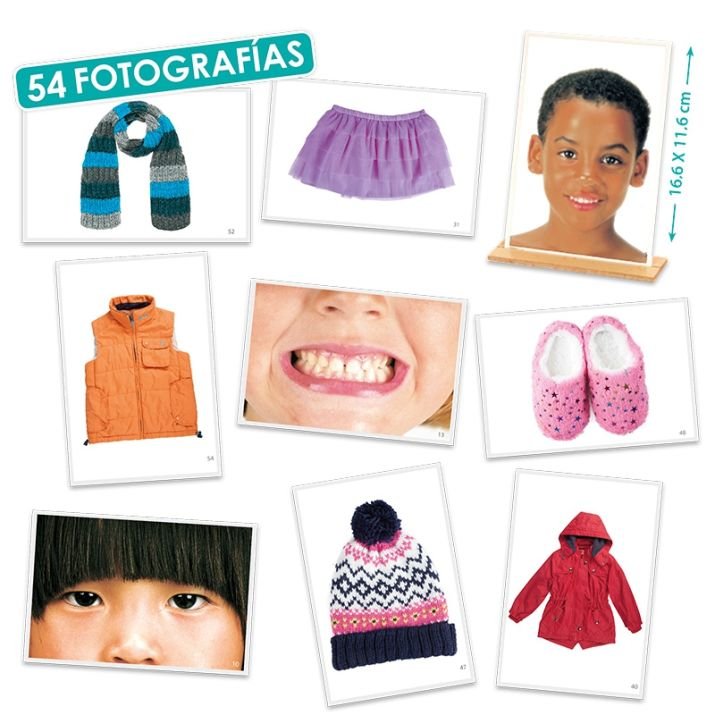

🎯 Where did that sock go, and what is an elbow called? The set “The Human Body and Clothes” holds 54 large, lifelike photographs that help children get to know the parts of the body and items of clothing and link the two: what we put on our feet, what we put on our heads. Two topics in one set – and both taken from the child’s own everyday life.
✨ What does this aid develop?
- Vocabulary – the names of body parts and clothes;
- Classifying and matching – which garment goes with which part of the body?
- Skills for independence – the order of getting dressed becomes clearer;
- Observation and narrative – describing, comparing, sequences.
🎲 How to play at home?
Name things, sort them (body / clothes; winter / summer wear) and look for pairs: gloves for the hands, a hat for the head. In the mornings, play “the getting-dressed plan” – the child lays out from the photographs what they will wear today, and only then gets dressed. Body parts are fun to learn in front of a mirror: find it in the photograph, point to it on yourself.
🧑🏫 Tips for professionals
For speech and language therapists this is double vocabulary material with a natural grammatical follow-on: body parts lead into describing qualities and into plural forms, while clothes lead into verbs (to put on, to pull on, to slip on, to fasten – the Lithuanian verbs for getting dressed are a lesson all of their own!). The classification list and the handy carry case (24 × 19 × 7,5 cm) make daily work easier, and the FSC certified materials are a sustainable choice for an institution.
📦 What is in the set?
- 54 large photographs: body parts and clothes (16,6 × 11,6 cm);
- a numbered classification list;
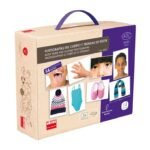
- a handy carry case for storage (24 × 19 × 7,5 cm).
👶 Who is it for?
Recommended for children aged 3–8. For speech and language therapists, nurseries and families – an aid that joins language teaching to the everyday ritual of getting dressed.
Reviews
There are no reviews yet.