


Resources for Children on the Autism Spectrum
Every child on the autism spectrum (ASD) is different: for one, noise or bright light is hard to bear, another seeks strong sensations, and a third finds it hardest to express what they want. That is why there is no single “right” resource – there are resources that help with a particular need. In this guide we have gathered learning resources grouped by what they are for: the senses, touch, oral sensations, communication, emotions and visual attention.
Resources do not replace professional support. If your child sees an occupational therapist, speech therapist or special education teacher, talk to them – they will help you choose what suits your child and show you how to use it.
Sensory regulation and calming
Many children on the autism spectrum react strongly to sensory input or, on the contrary, seek it out. Resources that provide deep pressure, a sense of touch or something to squeeze are often used to create a calm, predictable activity. Weighted items, such as a weighted shoulder wrap, are best discussed with an occupational therapist first – they will advise how long and in which situations to use them.

 14,00 € Select options This product has multiple variants. The options may be chosen on the product page
- Original price was: 16,00 €.14,40 €Current price is: 14,40 €. Select options This product has multiple variants. The options may be chosen on the product page


Touch and tactile games
Tactile games let children explore different textures safely and playfully: rough, smooth, soft, hard. Playing together, the child learns to name sensations, while the adult sees which textures the child enjoys and which they avoid. You will find more resources like these in the Tactile toys category.


Oral sensations and chewing
Some children chew sleeves, pencils or other objects. Special safe chew tools provide the same sensation and are suitable for use under adult supervision. Oral motor tools are usually chosen by a speech therapist – learn more in the Oral motor tools category and in our article about ARK Therapeutic tools.
 19,00 € Select options This product has multiple variants. The options may be chosen on the product page
 19,00 € Select options This product has multiple variants. The options may be chosen on the product page
 19,00 € Select options This product has multiple variants. The options may be chosen on the product page
Communication and visual support
For many children on the autism spectrum, visual information is easier to understand than words. Photo cards help build vocabulary and talk about everyday actions, while sequence cards help children understand what happens first and what comes next (for example, a morning routine). For practical tips on developing language at home, see our article How to help a child on the autism spectrum develop language.




Emotions and social skills
Recognising emotions from facial expressions or situations is a skill that can be practised through play. Cards with real photos and situations help start conversations about how other people feel and what one could do. These games work well one-to-one with an adult as well as in a small group.


Visual attention and the light table
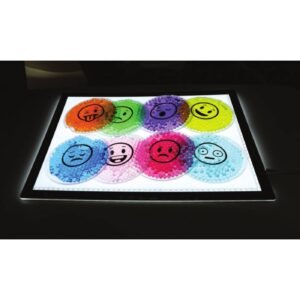
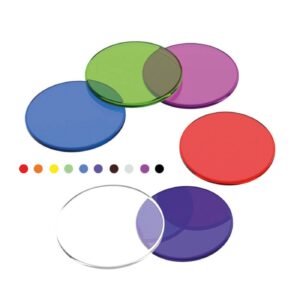
A light table with transparent shapes draws attention, and tasks are very easy to adapt: sort by colour, copy a pattern, count. It is a quiet, clearly structured activity that many children choose on their own.
How to choose a resource
- Start with the need, not the resource. What is hardest right now – calming down, focusing, expressing wishes, accepting new sensations?
- Observe your child. Which sensations do they seek and which do they avoid? That is the best clue where to start.
- Less is more. One or two new resources used regularly will do more than a full shelf.
- Build a routine. The same time, the same place and a clear beginning and end help the child feel safe.
- Talk to a professional. An occupational therapist, speech therapist or special education teacher will help you adapt the resource.
At home, at nursery and in the therapy room
At home, a few resources are enough for a calm corner and everyday play. For a nursery group or a therapy room, choose sturdy resources that several children can use. We invoice educational institutions – see For educational institutions. Resources for professionals are collected in a separate guide, Resources for professionals, and more general advice is in Resources for children with developmental difficulties.
A calm corner at home or in the group
Many children benefit from a place where they can take a break from noise and bustle. You do not need a separate room – a corner with a soft base, dimmed light and a few familiar resources is enough.
- Choose a quiet spot away from doors and sources of noise.
- Put out 2–3 resources the child already knows and likes – not the whole box at once.
- Agree that the corner is not a punishment but a place to calm down by choice.
- In a group, agree on a rule that only one child uses the corner at a time.
How to introduce a new resource
New things make some children anxious, so it is worth introducing a new resource gradually:
- Show it in advance. Tell the child or show a photo that today you will play a new game.
- Play first yourself. Let the child just watch at first how you use the resource.
- Short and clear. The first time, a few minutes with a clear ending (“two more times and we finish”) is enough.
- Repeat. The same game several days in a row helps the child get used to it and feel more confident.
Frequently asked questions
Which resource should we start with?
With the one that matches the biggest current need. If calming down is hard – start with sensory resources; if communication is hard – with visual cards. If in doubt, ask the professional who knows your child.
Are these resources only for children on the autism spectrum?
No. They are general learning resources used by other children, nursery groups and professionals too. In this guide we have grouped them by needs that are often relevant for children with ASD.
Can resources replace therapy?
No. Resources help with meaningful activities at home or in a group, but they do not replace professional work. They work best when used according to a professional’s recommendations.
Are weighted items suitable?
Weighted items are best used after talking to an occupational therapist, who will advise on the right weight and duration for your child. Always watch how your child feels and let them take the item off themselves.
How can an educational institution order?
At checkout choose the customer type “Educational institution”, or email us your list of products and we will prepare a quotation. Full details are on the page For educational institutions.
You will find more in the categories Sensory resources for children and Speech therapy resources. Not sure what to choose? Write to us – we will help.